Your Ultimate Guide to the StoryBrand Framework
Master the step by step StoryBrand process to create clear, customer-centric messaging that transforms your branding strategy.

25+ years in digital marketing | StoryBrand Certified Guide | HubSpot Platinum Partner | Author of 'Building a Business That Lasts'
Why StoryBrand is Essential for Your Business
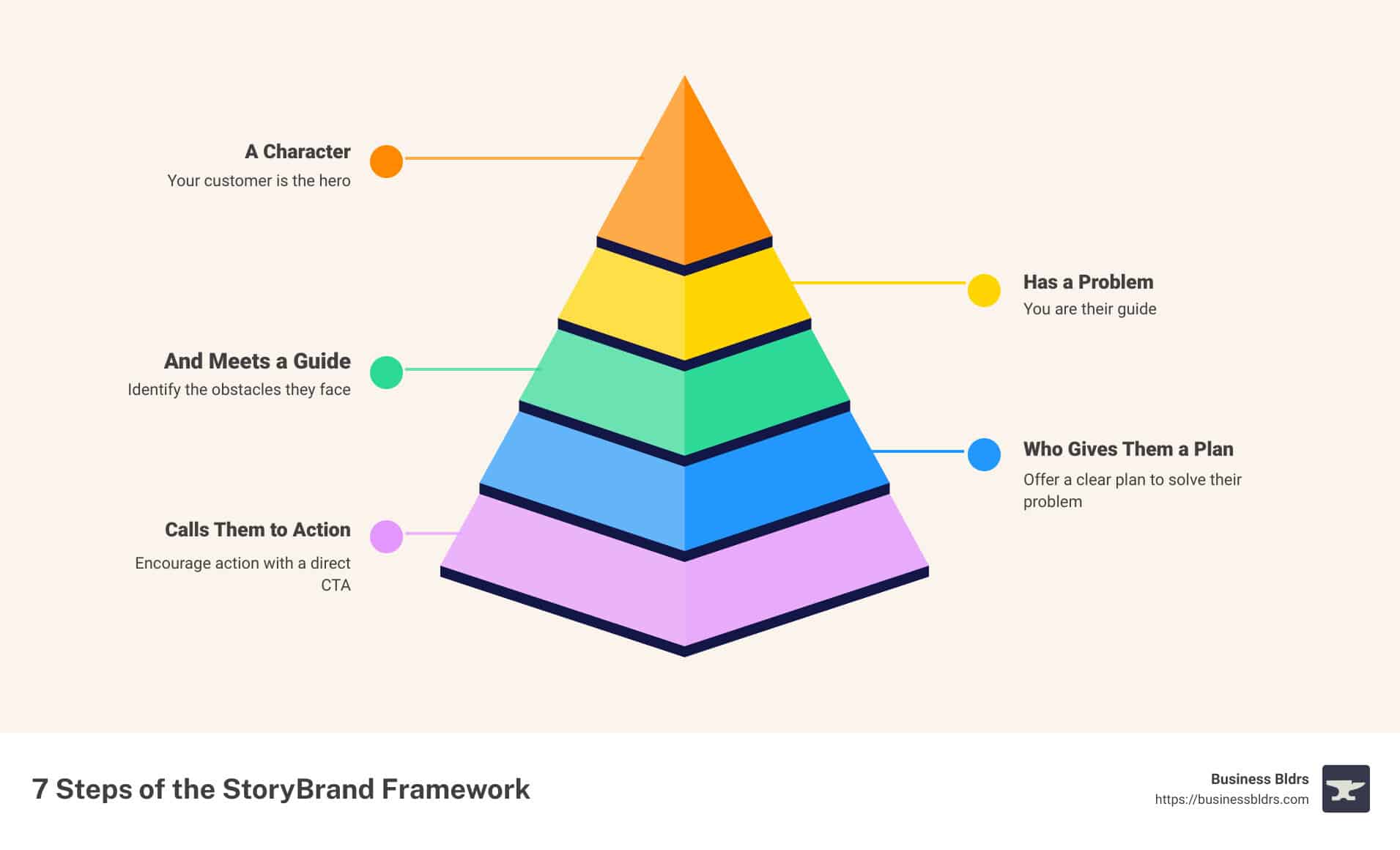
Understanding the step by step StoryBrand process can transform how your business communicates with customers. It's all about clarity, simplicity, and storytelling. Here’s a quick snapshot:
- A Character: Your customer is the hero.
- Has a Problem: Identify the obstacles they face.
- And Meets a Guide: You are their guide.
- Who Gives Them a Plan: Offer a clear plan to solve their problem.
- Calls Them to Action: Encourage action with a direct CTA.
- That Ends in Success: Show the happy ending.
- And Helps Them Avoid Failure: Highlight the risks of inaction.
The StoryBrand framework, developed by Donald Miller, helps businesses like yours create clear and compelling brand messages. This approach places your customer at the heart of the story, making them the hero. By doing that, you naturally draw them in and create a powerful connection.
Business Bldrs is dedicated to helping small business owners achieve consistent branding and a robust online presence. By using StoryBrand, you can develop a customer-centric approach that resonates deeply with your audience.

What is the StoryBrand Framework?
The StoryBrand Framework, created by Donald Miller, is a powerful tool designed to help businesses clarify their messaging. At its core, it leverages the timeless principles of storytelling to make your brand's message more engaging and customer-focused.
The Power of Storytelling
Storytelling has captivated human attention for thousands of years. It's a universal language that everyone understands. According to Donald Miller, "Your brain spends about 30% of its time daydreaming unless you’re listening to a story." This means that when you use storytelling in your marketing, you can grab and hold your audience's attention like nothing else.
The Hero's Journey
The StoryBrand Framework is built around the concept of the "hero's journey." In this narrative structure, the customer is the hero of the story. They have a problem they need to solve, and they are on a journey to find a solution.

Your Role as the Guide
In this framework, your business is not the hero. Instead, you take on the role of the guide. Think of yourself as Gandalf to Frodo, or Obi-Wan to Luke Skywalker. Your job is to help the hero (your customer) overcome obstacles and achieve their goals.
To be an effective guide, you need to demonstrate two key qualities:
- Empathy: Show that you understand the hero's problems and challenges.
- Authority: Prove that you have the expertise and resources to help them succeed.
Why the Customer is the Hero
When you position your customer as the hero, you make your message about them, not about you. This shift is crucial because people are naturally more interested in their own stories and problems. When you focus on your customer's journey, you create a strong emotional connection and make your message more compelling.
The Guide's Role in Action
Let's look at some real-world examples. Companies like Intel, Charity Water, and Chick-fil-A have successfully used the StoryBrand Framework to transform their messaging. By positioning their customers as heroes and themselves as guides, they've been able to create clear, engaging, and customer-centric messages.
Empathy and Authority in Practice
For instance, if you run an internet service provider, you could say:
- Empathy: "We understand how frustrating it is when your internet goes down during an important video call."
- Authority: "With over 10 years of experience and a 99% uptime guarantee, we ensure you stay connected when it matters most."
By following this step by step StoryBrand process, you can create a powerful narrative that resonates with your audience and drives them to take action.
Next, we'll dive into the seven steps of the StoryBrand Framework, starting with identifying the character in your story.
The 7 Steps of the StoryBrand Framework
1. A Character
Every story starts with a character. In the StoryBrand Framework, this character is your customer. They are the hero of your narrative, not your brand.
Example: If you run a lawn care company, your customer is the homeowner who wants a beautiful yard.
Key Point: Clearly define what your customer wants. This keeps your messaging focused and relevant.
2. Has a Problem
Your customer has a problem that needs solving. This problem can be broken down into three levels:
- External Problem: The tangible issue they face.
- Internal Problem: How this problem makes them feel.
- Philosophical Problem: Why this problem matters in a larger context.
Example: The homeowner's lawn is full of weeds (external), which makes them feel frustrated and embarrassed (internal), and they believe they deserve a beautiful yard (philosophical).
Villain: Identify a villain that represents the problem. For the lawn care company, the villain could be the invasive weeds.
3. And Meets a Guide
Your brand steps in as the guide, not the hero, to help the customer solve their problem. You need to show two things:
- Empathy: Show you understand their struggles.
- Authority: Prove you can help them overcome these struggles.
Example: "We understand how frustrating it is to have a yard overrun by weeds (empathy). With over 20 years of experience in lawn care, we guarantee a weed-free lawn (authority)."
4. Who Gives Them a Plan
Provide a clear, simple plan that shows how the customer can achieve their goal. This plan should have two parts:
- Process Plan: Outline the steps to do business with you.
- Agreement Plan: Offer assurances to alleviate fears.
Example: 1. Call us for a free lawn assessment. 2. Get a customized lawn care plan. 3. Enjoy a beautiful, weed-free lawn.
5. And Calls Them to Action
A clear Call to Action (CTA) is essential. There are two types of CTAs:
- Direct CTA: Encourages immediate action.
- Transitional CTA: Nurtures the relationship for future action.
Example: "Call us now for a free lawn assessment" (Direct CTA) or "Download our free guide to a healthy lawn" (Transitional CTA).
6. That Ends in Success
Paint a picture of what success looks like for your customer. Show them the positive outcome they can achieve.
Example: "Imagine a lush, green lawn where your kids can play and you can relax, free from the worry of weeds."
7. And Helps Them Avoid Failure
Highlight the consequences of not taking action. This adds urgency and reinforces the need for your solution.
Example: "Without proper lawn care, weeds will continue to spread, making your yard look worse and decreasing your home's curb appeal."
By following these seven steps, you create a compelling story that places your customer at the center, clearly communicates how you can help them, and motivates them to take action. Next, we'll explore how to implement the StoryBrand Framework into your business strategy.
1. A Character
Every great story starts with a character who wants something. In the StoryBrand framework, this character is your customer. They are the hero of the story, and your business is here to guide them.
Customer Desire
Your customer has desires and aspirations. They want to achieve something or become someone. Think of it this way: the story begins when the character wants something. It’s your job to know exactly what that is.
Target Audience
To understand your customer, you need to identify your target audience. Who are they? What are their needs and desires? The more specific you can be, the better. For example, if you sell fitness equipment, your target audience might be individuals who want to get in shape and live healthier lives.
Hero
In your brand story, the customer is the hero. This means all your messaging should be centered around them and their journey. Avoid the common mistake of making your brand the hero. Instead, position your brand as the guide that helps the hero achieve their goals.
Customer Needs
Understanding your customer’s needs is crucial. These needs can be categorized into three types:
- External Needs: These are the surface-level problems your customer faces. For example, needing a reliable internet connection for a home office.
- Internal Needs: These are the emotional struggles they experience. For instance, feeling overwhelmed or frustrated when their internet is unreliable.
- Philosophical Needs: These are the deeper reasons why solving this problem matters. It’s wrong that your customer should have to deal with unreliable internet in a world where digital connectivity is essential.
By clearly identifying and addressing these needs, you invite your customer into a story that has a clear direction. This makes it easier for them to see themselves in the narrative and engage with your brand.
Next, we’ll dive into the problems your customer faces and how to address them effectively.
2. Has a Problem
In every great story, the hero faces challenges. Your customer is no different. To connect with them, you need to clearly identify the problems they face. These problems come in three levels: external, internal, and philosophical. Understanding these will help you craft a compelling narrative that resonates deeply.
External Problem
The external problem is the obvious, tangible issue your customer is dealing with. Think of it as the obstacle right in front of them. For example, if you run an internet service company, the external problem might be unreliable internet service. This is what your customer is actively trying to fix.
Example: A winery client might see their external problem as low foot traffic to their tasting room. This is the straightforward, surface-level issue.
Internal Problem
The internal problem digs deeper. It’s about how the external problem makes your customer feel. This is often a feeling like frustration, embarrassment, or confusion. It’s not just that they have unreliable internet; it’s that they feel frustrated because they can’t work from home effectively.
Example: For the winery, the internal problem might be the owner's feeling of frustration and self-doubt because they can't attract more visitors despite their efforts.
Philosophical Problem
The philosophical problem is the moral or ethical angle. It’s about why it’s just plain wrong that your customer has to deal with this issue. This taps into a deeper sense of justice and can be very powerful.
Example: For the winery, the philosophical problem might be that it’s wrong for such a high-quality, family-run business to struggle when they offer an exceptional product.
The Villain
Every story needs a villain. This isn’t your competition but rather the root cause of your customer’s problems. It could be a concept, a situation, or a mindset. Identifying this helps your customer see you as their ally in overcoming the villain.
Example: For the winery, the villain might be the rise of large, commercial wineries that overshadow small, quality-focused vineyards.
By understanding these layers of problems—external, internal, and philosophical—you can craft a narrative that shows you truly understand your customer's struggles. This sets the stage for you to step in as their guide.
Next, we'll explore how to position yourself as the guide who can help your customer overcome these challenges.
3. And Meets a Guide
Once you've identified your customer's problems, it's time for your brand to step in as the guide. This is a crucial part of the step by step StoryBrand process. Your role is to show both empathy and authority, making it clear that you understand your customer's struggles and that you have the expertise to help them overcome these challenges.
Show Empathy
Empathy is about showing your customers that you truly get what they are going through. It's not just about saying "We understand," but demonstrating it through your messaging and actions.
Example: Imagine a small business owner struggling with online marketing. You could say, "We know how overwhelming digital marketing can be. We've helped countless small businesses like yours cut through the noise and reach their audience effectively."
Empathy helps your customers feel seen and understood, making them more likely to trust you.
Demonstrate Authority
While empathy connects you emotionally to your customers, authority reassures them that you have the skills and experience to guide them to success. You can demonstrate authority by showcasing your expertise and past successes.
Example: "Over the past decade, we've helped over 500 small businesses double their online presence through our proven marketing strategies."
By highlighting your track record, you show that you have what it takes to help them solve their problems.
The Guide Role
In the StoryBrand framework, you are not the hero—your customer is. Your role is to be the wise guide who helps the hero succeed. Think of characters like Yoda from Star Wars or Gandalf from The Lord of the Rings. These guides are experienced, wise, and supportive.
Example: "Just like Yoda guided Luke Skywalker, we're here to guide you through the complexities of digital marketing, helping you grow your business step by step."
Brand Positioning
Positioning your brand as the guide involves crafting your messaging to highlight both your empathy and authority. This helps build trust and makes it clear that you are the best choice to help your customers overcome their challenges.
Practical Tip: Use testimonials and case studies to show real-world examples of how you've helped others. "Our clients have seen a 50% increase in their online engagement within the first three months of working with us."
By combining empathy and authority, you position your brand as a trusted guide, ready to help your customers achieve their goals.
Next, we'll look at how to create a clear plan that will guide your customers toward success.
4. Who Gives Them a Plan
Once you've shown empathy and authority, it's time to give your customers a clear plan. This plan will guide them on how to achieve what they want.
Process Plan
The process plan is a simple, step-by-step guide that tells customers how to do business with you. It should be clear and concise, ideally with 3-4 steps. This helps avoid overwhelming your customers with too much information.
Example:
- Schedule a Consultation: Book a free 30-minute call with our experts.
- Create a Custom Plan: We'll develop a custom strategy for your needs.
- Start Your Journey: Begin implementing the plan and see results.
Why It Matters: A clear process plan removes uncertainty. It makes the path to success straightforward and inviting.
Agreement Plan
The agreement plan is about reassuring your customers. This plan shows your commitment to their success and alleviates their fears.
Example:
- Money-Back Guarantee: If you're not satisfied within 30 days, get a full refund.
- 24/7 Support: Access our support team anytime you need help.
- Regular Check-Ins: We'll have monthly meetings to track progress and make adjustments.
Why It Matters: An agreement plan builds trust. It shows customers that they are safe and supported, even if something goes wrong.
Clear Instructions
Both plans should be easy to understand. Use simple language and avoid jargon. Imagine you're explaining the process to a friend who knows nothing about your business.
Pro Tip: Use visuals like flowcharts or infographics to make the steps even clearer. For instance, a simple diagram can show the journey from the first consultation to achieving the final goal.
Step-by-Step
Keep your instructions short and actionable. Break down complex processes into smaller, manageable steps.
Example:
- Sign Up: Fill out a short form on our website.
- Initial Meeting: Meet with our team to discuss your goals.
- Plan Delivery: Receive a detailed plan within a week.
- Implementation: Start following the plan with our guidance.
Why It Matters: A step-by-step approach removes confusion and makes it easier for customers to take action.
By providing a process plan and an agreement plan, you not only guide your customers but also build their confidence in your brand. Next, we’ll explore how to call your customers to action effectively.
5. And Calls Them to Action
Once your customer has a clear plan, it's time to nudge them towards action. This is where the call to action (CTA) comes into play. A well-crafted CTA can transform a casual visitor into an engaged customer.
Direct Call to Action
A direct call to action asks your customers to take a specific step, like "Buy Now," "Schedule a Call," or "Sign Up Today." It’s straightforward and leaves no room for ambiguity.
Example: A lawn care company might use "Call Us Now" as their direct CTA. This clear instruction tells the customer exactly what to do next.
Why It Works: Emails with a CTA can boost sales by up to 1617%, according to research. So, don’t be shy about asking your customers to take action. They expect it.
Transitional Call to Action
Not everyone is ready to make a big commitment right away. That’s where a transitional call to action comes in. This type of CTA offers something of value in exchange for a small action, like giving an email address.
Examples: - Free eBook - Discount Code - Webinar Signup - Lead-Generating PDF
Why It Works: A transitional CTA builds trust and keeps the customer engaged, even if they're not ready to buy immediately. It’s a low-risk way for them to learn more about your brand.
Clear CTA
Clarity is key. A CTA should be impossible to miss. Use bold text, bright colors, and place it prominently on your webpage.
Tips for a Clear CTA: - Be Specific: Use action words like "Download Now" or "Get Started." - Highlight Benefits: Let customers know what they’ll gain. For example, "Join Our Webinar to Learn 5 Marketing Secrets." - Keep It Simple: Don’t clutter your CTA with too much text. One clear message is enough.
Example: Yeti, the outdoor products company, uses CTAs like "Shop Now" and "Explore Gear" to guide customers directly to their products. This clear direction has helped boost their engagement and sales.
Putting It All Together
Combining both direct and transitional CTAs on your website can cater to different customer readiness levels. For instance, your homepage might feature a direct CTA like "Buy Now" while offering a transitional CTA like "Download Our Free Guide" for those who need more information.
By making your CTAs clear and compelling, you guide your customers on what to do next, reducing hesitation and increasing conversions.
Next, we'll discuss how to paint a picture of success for your customers.
6. That Ends in Success
Success Outcome
Imagine your customer standing on the other side of their problem, beaming with satisfaction. That's what you need to convey in this step. Paint a vivid picture of the success outcome they can achieve by using your product or service.
Take the example of a lawn care company. Instead of just saying, "We'll make your lawn look good," go deeper. Describe a lush, green lawn where kids play, picnics happen, and neighbors envy. Show them the dream.
Customer Goals
To resonate deeply, you need to align your messaging with your customer's goals. What do they really want? Is it more time, more money, or perhaps peace of mind?
For instance, if you're a software company, your customer's goal might be to save time on repetitive tasks. Don't just tell them your software is efficient. Illustrate how they can reclaim hours in their day to focus on what truly matters to them, like growing their business or spending time with family.
Positive Resolution
Finally, wrap it up with a positive resolution. This is where you tie everything together—how your product or service not only solves their problem but leads to a happier, more fulfilled life.
Think about a fitness program. Instead of just saying "Get fit," show the joy and confidence they’ll feel walking on the beach in their new physique. Use real-life examples and vivid language to make this change feel not just possible, but inevitable.
Pro-Tip: Use at least 6-7 success points to make the picture of success as clear as possible. This will make your customer more likely to take action.
By focusing on these elements, you can create a compelling narrative that not only highlights the benefits of your product or service but also connects emotionally with your audience.
Next, we'll discuss how to help your customers avoid failure.
7. And Helps Them Avoid Failure
Helping your customers avoid failure is just as important as guiding them to success. It’s essential to show them the risks and consequences they might face if they don’t take action. This can be a powerful motivator.
Failure Risks
People often fear failure more than they desire success. To tap into this, you must clearly outline the risks of not solving their problem:
-
Missed Opportunities: Highlight what they will miss out on if they don’t use your product or service. For example, if you offer a time management app, explain how they might miss deadlines and lose clients without it.
-
Wasted Resources: Show how they might waste time, money, or effort by not choosing the right solution. For instance, if you sell eco-friendly products, explain the long-term costs of sticking with less sustainable options.
-
Increased Stress: Point out the emotional toll of unresolved problems. If you offer financial planning services, mention the stress and anxiety that comes with financial uncertainty.
Consequences
Clearly explain the consequences of inaction. Use vivid language to make these outcomes feel real and immediate:
"If you don’t take control of your finances now, you risk falling into debt and facing financial instability in the future."
-
Long-term Impact: Describe how the problem could worsen over time. For example, if you provide health coaching, explain how ignoring their health could lead to chronic illnesses.
-
Reputation Damage: Mention how not addressing the problem could harm their reputation. If you offer PR services, discuss how a single PR crisis can tarnish their brand image.
Avoiding Pitfalls
Guide your customers on how to avoid these pitfalls by using your product or service:
-
Step-by-Step Guidance: Offer clear, actionable steps to avoid failure. This reassures customers that they can succeed with your help.
-
Success Stories: Share testimonials and case studies to show how others have avoided failure by choosing your solution. This builds trust and credibility.
-
Guarantees and Assurances: Provide guarantees, like a money-back promise, to alleviate fears. This reduces the perceived risk of taking action.
By focusing on these elements, you can effectively motivate your customers to take the necessary steps to avoid failure. This not only helps them but also positions your brand as a reliable guide.
Next, we’ll explore how to implement the StoryBrand Framework in your business.
How to Implement the StoryBrand Framework
Implementing the StoryBrand Framework in your business can transform your marketing strategy. Here’s a step-by-step guide to get you started.
Step 1: Create Your BrandScript
A BrandScript is a blueprint for your brand's story. It helps you outline the key elements of the StoryBrand Framework.
- Identify Your Customer (The Hero): Understand who your customers are and what they want.
- Define Their Problem: Pinpoint the external, internal, and philosophical problems they face.
- Position Yourself as the Guide: Show empathy and authority to build trust.
- Outline a Clear Plan: Provide simple steps that show how your product or service can help.
- Call Them to Action: Include direct and transitional calls to action.
- Describe Success: Paint a picture of how their life will improve.
- Highlight Failure: Show what they risk by not taking action.
Step 2: Craft Clear Messaging
Your message should be simple and customer-centered. Avoid jargon and focus on how you solve your customers' problems.
- Use Simple Language: Keep it easy to understand.
- Focus on Benefits: Highlight what’s in it for the customer.
- Be Consistent: Use the same message across all platforms.
Step 3: Map the Customer Journey
Understand the journey your customers take from finding your brand to making a purchase.
- Awareness: How do they find you?
- Consideration: What makes them consider your product?
- Decision: What convinces them to buy?
Step 4: Practical Steps to Implement
- Update Your Website: Use your BrandScript to revise your website content. Ensure your homepage clearly states who you are, what you offer, and how it benefits the customer.
- Revamp Marketing Materials: Align your brochures, emails, and social media posts with your BrandScript.
- Train Your Team: Ensure everyone understands and uses the BrandScript in their communications.
- Monitor and Adjust: Regularly review how well your message resonates with customers and make adjustments as needed.
Example
Here's how a lawn care company might implement their BrandScript:
- Character: Homeowners who want a beautiful lawn.
- Problem: Their lawn is unattractive and they don’t know how to fix it.
- Guide: The lawn care company shows empathy and expertise.
- Plan: Clear steps to get a lush lawn.
- Call to Action: “Call Us Now.”
- Success: A beautiful, envy-worthy lawn.
- Failure: An unattractive lawn that lowers curb appeal.
By following these steps, you can create a powerful narrative that resonates with your customers and sets your brand apart.
Next, we’ll dive into a detailed, step-by-step process to create your StoryBrand.
Step by Step StoryBrand Process
Creating a StoryBrand involves a clear, step-by-step process. Let's break it down:
1. Identify Your Target Audience
Before you can tell a story, you need to know who you're telling it to. Identifying your target audience is crucial. Think beyond demographics. Ask:
- What are their needs and desires?
- What problems are they facing?
- What motivates them?
For instance, if you’re a lawn care company, your target audience might be homeowners who want a beautiful lawn but don’t have the time or knowledge to achieve it.
2. Build a Storytelling Framework
The StoryBrand framework is built like a classic story structure. This structure helps make your brand message clear and engaging. Here’s a quick recap:
- A Character: Your customer is the hero.
- Has a Problem: Identify their external, internal, and philosophical problems.
- And Meets a Guide: Position your brand as the guide with empathy and authority.
- Who Gives Them a Plan: Provide a clear, simple plan to solve their problem.
- And Calls Them to Action: Make your call to action direct and clear.
- That Ends in Success: Paint a vivid picture of what success looks like.
- And Helps Them Avoid Failure: Highlight the consequences of not taking action.
3. Make an Emotional Connection
People make decisions based on emotions. Your story should connect emotionally with your audience. Use relatable scenarios and language that resonates with their feelings and experiences.
For example, instead of just saying "We make lawns green," you could say, "Imagine your kids playing on a lush, green lawn, free from weeds."
4. Gather Feedback and Revise
Your first draft won’t be perfect. Gather feedback from your audience and stakeholders. Ask:
- Does this story resonate with you?
- Are the steps clear and easy to follow?
- Does the call to action compel you to act?
Use this feedback to refine your story. No message is ever 100% perfect. Continually tweak and improve it to better connect with your audience.
Putting It All Together
Once you have all the elements, put them together into a cohesive BrandScript. This script will be the foundation of all your marketing messages. You can always return to these points to ensure your messaging stays on track and resonates with your audience.
Next, we’ll answer some frequently asked questions about the StoryBrand Framework.
Frequently Asked Questions about the StoryBrand Framework
What are the 7 steps of StoryBrand?
The StoryBrand Framework is built around seven key steps. These steps help you turn your brand's message into a compelling story that puts your customer at the center. Here they are:
- A Character: Your customer is the hero of the story.
- Has a Problem: Identify the problems your customer faces, including external, internal, and philosophical problems.
- And Meets a Guide: Your brand acts as the guide, showing empathy and authority.
- Who Gives Them a Plan: Provide a clear plan to help the customer solve their problem.
- And Calls Them to Action: Encourage the customer to take action with clear and direct CTAs.
- That Ends in Success: Show how your solution leads to success.
- And Helps Them Avoid Failure: Highlight the consequences of not solving the problem.
These steps create a roadmap that makes your messaging clear and engaging. For more details on each step, check out our section on The 7 Steps of the StoryBrand Framework.
How to create your StoryBrand?
Creating your StoryBrand involves the following steps:
- Identify Your Customer: Understand who your customer is and what they want.
- Define Their Problem: Pinpoint the external, internal, and philosophical problems they face.
- Position Your Brand as the Guide: Show empathy and authority to build trust.
- Create a Clear Plan: Outline a simple, actionable plan to help your customer achieve their goals.
- Call to Action: Design clear and compelling calls to action.
- Paint a Picture of Success: Describe what success looks like for your customer.
- Emphasize Avoiding Failure: Highlight what they risk if they don't take action.
Once you have these elements, combine them into a cohesive BrandScript. This will be the foundation for all your marketing messages. For a detailed guide on creating your StoryBrand, read our section on How to Implement the StoryBrand Framework.
What is the process of brand storytelling?
Brand storytelling is about making your customer the hero and your brand the guide. Here's how to do it:
- Start with Your Customer: Identify their desires and what they want to achieve.
- Introduce the Problem: Clearly define the problems they face.
- Position Yourself as the Guide: Show empathy for their struggles and authority in solving their problems.
- Provide a Plan: Offer a clear, step-by-step plan to help them succeed.
- Call to Action: Use direct and transitional calls to action to encourage them to take the next step.
- Show Success: Illustrate what success looks like for them after using your product or service.
- Highlight the Risks of Failure: Emphasize the consequences of not taking action.
This process ensures your message is clear, compelling, and customer-focused. For more insights on brand storytelling, see our detailed section on Step by Step StoryBrand Process.
Next, we’ll wrap up our guide with some final thoughts on how to leverage the StoryBrand Framework for your business.
Conclusion
At Business Bldrs, we believe that a powerful story can transform your brand. The StoryBrand Framework offers a comprehensive blueprint for creating clear, engaging, and customer-centric messaging.
Why Choose Business Bldrs?
We specialize in branding and web development. Our team uses the StoryBrand Framework to craft messages that resonate with your target audience. We don’t just help you tell your story; we help you tell it in a way that connects emotionally with your customers.
Our Process
- Find Your Unique Value Proposition: We work with you to understand what makes your brand unique.
- Develop Clear Messaging: Using the StoryBrand Framework, we create messaging that speaks directly to your customers' needs.
- Build a Customer-Centric Website: Our web development team designs a site that guides your customers through their journey, making it easy for them to take action.
- Create Targeted Content: We produce content that aligns with your brand story and engages your audience across all platforms.
Ready to Transform Your Brand?
If you're ready to create a clear and compelling brand story, we're here to help. Learn more about how we can assist you in leveraging the StoryBrand Framework to grow your business.
Find how Business Bldrs can help you craft your brand story today!
By following the StoryBrand Framework, you can ensure your messaging is not only clear but also compelling and customer-focused. Let’s make your brand story one that your customers will remember and love.
Let us walk you through the process. As a StoryBrand Certified Agency, Business Builders guides you step-by-step from confused messaging to clear, converting communication.
Ready to Grow Your Business?
Put these insights into action with our expert team. We help businesses like yours achieve measurable results.