The Ultimate Guide to Digital Marketing Growth Strategies
Discover top digital marketing growth strategies and learn how to drive business success with targeted content and clear messaging.

25+ years in digital marketing | StoryBrand Certified Guide | HubSpot Platinum Partner | Author of 'Building a Business That Lasts'
Mastering Digital Marketing Growth Strategies
In today’s digital age, digital marketing growth strategies are essential for any business wanting to expand its reach and increase its revenue. Whether you’re a small business owner struggling with inconsistent branding or facing challenges with your online presence, understanding and implementing effective digital marketing growth strategies can transform your business.
Quick Fact: What are the key digital marketing growth strategies?
- Content Marketing: Creating and sharing valuable content to attract and engage your audience.
- SEO (Search Engine Optimization): Optimizing your online content to rank higher in search engine results.
- Paid Advertising: Using digital ads to reach a larger audience.
- Social Media Marketing: Engaging with your audience on platforms like Facebook, Instagram, and TikTok.
- Email Marketing: Sending targeted email campaigns to your subscribers.
My name is Jay Owen, and with over 25 years of experience in web design and marketing communications, I have seen how digital marketing growth strategies can turn a business around. Through clear messaging and effective strategies, I’ve helped numerous businesses boost their online presence and drive growth.

Quick digital marketing growth strategies definitions: - They Ask You Answer Methodology - branding strategies for startups - comprehensive branding solutions
Understanding Digital Marketing Growth Strategies
What Are Digital Marketing Growth Strategies?
Digital marketing growth strategies are plans designed to help businesses increase their online presence, attract more customers, and ultimately boost sales. These strategies include a variety of tactics, such as content marketing, SEO, and social media engagement, all aimed at reaching a specific audience.
Why Are They Important?
Digital marketing growth strategies are crucial for several reasons:
- Actionable Goals: They provide your team with clear, actionable goals.
- Budget Allocation: They help in efficiently allocating your marketing budget.
- Focus: They allow you to focus your marketing efforts, saving both time and money.
- Targeting: They help you identify and target the right audience.
Aligning with Business Goals
Your digital marketing strategy should align with your business goals. For example, if your goal is to increase online revenue by 20%, your marketing efforts should focus on generating more leads and converting them into sales.
Customer Acquisition
One of the primary objectives of digital marketing growth strategies is customer acquisition. This involves attracting new customers through various channels such as:
- SEO: Improving your website's visibility on search engines.
- Content Marketing: Creating valuable content that attracts potential customers.
- Paid Advertising: Using ads to reach a wider audience.
Customer Retention
Equally important is customer retention. Keeping your existing customers engaged and satisfied can lead to repeat business and referrals. Strategies for retention include:
- Email Marketing: Sending personalized emails to keep customers informed and engaged.
- Social Media Engagement: Interacting with customers on social media platforms.

By combining these elements, you can create a comprehensive digital marketing strategy that not only attracts new customers but also keeps your existing ones coming back.
Next, we will dive into the key elements that make up a successful digital marketing strategy.
Key Elements of a Successful Digital Marketing Strategy
In the changing world of digital marketing, certain elements are fundamental to building a successful strategy. Let's explore these key components:
Responsive Website
A responsive website is crucial. With over 85% of people searching online using mobile devices, your site must look and function well on all screen sizes. Google also prioritizes mobile-friendly sites in search rankings, making this a non-negotiable aspect of your strategy.
Key Features of a Responsive Website: - Fast loading times - Mobile-friendly design - Easy navigation - Clear call-to-action (CTA) buttons
Engaging Content
Content is king in digital marketing. Engaging content attracts and retains your audience, building trust and authority in your industry. According to HubSpot, 92% of marketers are boosting their investments in blogging in 2024.
Types of Engaging Content: - Blog posts - Videos - Infographics - Podcasts
SEO Strategy
Search Engine Optimization (SEO) is the process of improving your website to rank higher in search engine results. The more visible your site, the more traffic and potential customers you attract.
SEO Best Practices: - Keyword research - On-page optimization (title tags, meta descriptions) - High-quality backlinks - Regularly updated content
Email Marketing
Email marketing remains one of the most effective digital marketing growth strategies. It allows you to send personalized messages directly to your audience, keeping them informed and engaged.
Effective Email Marketing Tactics: - Segmented email lists - Personalized content - Automated email sequences - Regular newsletters
Social Media Marketing
Social media marketing involves using platforms like Facebook, Instagram, and Twitter to reach and engage your audience. Being active on social media helps you build a community and foster customer loyalty.
Social Media Best Practices: - Consistent posting schedule - Engaging with followers - Utilizing stories and live videos - Running targeted ads
Digital Advertising
Digital advertising includes paid ads on search engines, social media, and other websites. It’s a direct way to reach your target audience and drive immediate traffic to your site.
Types of Digital Advertising: - Pay-per-click (PPC) ads - Social media ads - Display ads - Retargeting ads
By incorporating these key elements into your digital marketing strategy, you can create a robust plan that drives growth and achieves your business goals.
Next, we will dig into the different types of digital marketing growth strategies.
Types of Digital Marketing Growth Strategies
Digital marketing growth strategies are essential for businesses aiming to expand their reach and increase revenue. Here, we explore four key types of growth strategies: market penetration, market development, product development, and diversification.
Market Penetration
Market penetration is about increasing your market share within existing markets using your current products. This is often the first strategy businesses pursue because it involves less risk.
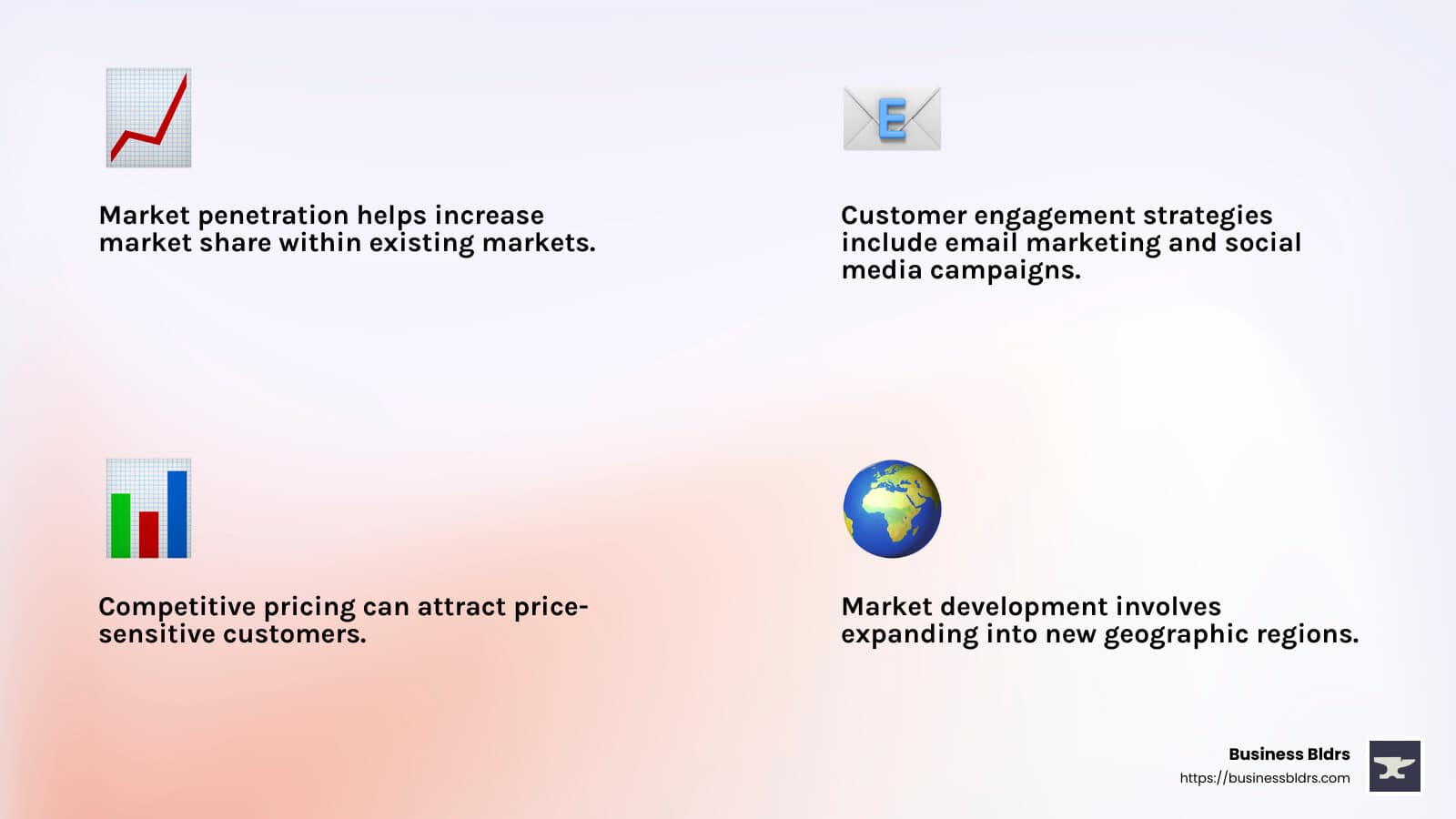
Tactics for Market Penetration: - Increase marketing efforts: Boost your advertising and promotional activities to attract more customers. - Improve customer engagement: Use email marketing and social media campaigns to deepen relationships with existing customers. - Competitive pricing: Offer discounts or competitive pricing to attract price-sensitive customers.

Market Development
Market development involves expanding your reach into new markets with your existing products. This strategy is useful when your current market is saturated, and you need new opportunities for growth.
Steps for Market Development: - Identify new geographic regions: Look for areas where your products are not yet available. - Target new customer segments: Find new demographics that could benefit from your products. - Adapt marketing strategies: Tailor your messaging and advertising to resonate with the new market.

Product Development
Product development focuses on creating new products to serve your existing market. This strategy can help you meet changing customer needs and stay ahead of competitors.
Approaches to Product Development: - Innovate: Develop new features or entirely new products based on customer feedback and market research. - Improve existing products: Make improvements to your current offerings to add value and attract more customers. - Test and iterate: Use A/B testing and customer feedback to refine new products before a full-scale launch.

Diversification
Diversification is the most ambitious growth strategy, involving the introduction of new products into new markets. While it carries the highest risk, it also offers the potential for significant rewards.
Types of Diversification: - Related diversification: Enter markets that are related to your current business, leveraging your existing expertise. - Unrelated diversification: Venture into entirely new industries, which can help spread risk across different sectors. - Partnerships and acquisitions: Collaborate with or acquire other companies to gain a foothold in new markets.

By understanding and implementing these digital marketing growth strategies, businesses can effectively steer their growth journey and achieve sustainable success.
Next, we will dig into the top digital marketing tactics for growth.
Top Digital Marketing Tactics for Growth
To grow your business online, you need effective digital marketing growth strategies. Let's explore the top tactics that can help you achieve significant growth.
Search Engine Optimization (SEO)
SEO involves improving your website to rank higher in search engine results. The higher you rank, the more visibility you get. Here are some key elements of SEO:
- Keyword Research: Identify the words and phrases your target audience uses.
- On-Page SEO: Optimize your website’s content, titles, and meta descriptions.
- Off-Page SEO: Build backlinks from other reputable websites.
- Technical SEO: Ensure your site is fast, mobile-friendly, and easy to steer.
For example, companies that regularly update their blogs with relevant keywords see a significant boost in traffic. According to HubSpot, 92% of marketers are increasing their investment in blogging in 2024.
Content Marketing
Content marketing is about creating valuable content to attract and engage your audience. This can include blog posts, videos, infographics, and more.
- Educational Content: Provide useful information that solves problems for your audience.
- Storytelling: Share stories that resonate with your audience to build a connection.
- Consistency: Regularly update your content to keep your audience engaged.
HubSpot's free blog maker is a great tool to help businesses get started with content marketing. The goal is to build trust and establish thought leadership.
PPC Advertising
Pay-Per-Click (PPC) advertising involves paying for ads that appear on search engines and social media platforms. You only pay when someone clicks on your ad.
- Google Ads: Target specific keywords to appear in search results.
- Social Media Ads: Use platforms like Facebook and Instagram to reach specific demographics.
- Budget Management: Set a budget and track your spending to ensure a good return on investment.
PPC is highly effective because it allows you to target your audience precisely and see immediate results.
Business Branding
Business branding is about creating a strong, recognizable brand that stands out in the market.
- Brand Identity: Develop a unique logo, color scheme, and voice.
- Consistency: Ensure your branding is consistent across all channels.
- Reputation Management: Monitor and manage online reviews and customer feedback.
A strong brand can differentiate you from competitors and build customer loyalty.
Social Media Marketing
Social media marketing involves using platforms like Facebook, Instagram, and Twitter to promote your business.
- Engagement: Interact with your audience through comments, messages, and posts.
- Content Sharing: Share valuable content that your audience will find interesting.
- Influencer Partnerships: Collaborate with influencers to reach a broader audience.
Social media is crucial for building a community around your brand and engaging with your customers.
Conversion Rate Optimization (CRO)
Conversion Rate Optimization (CRO) is about increasing the percentage of visitors who take a desired action on your website, such as making a purchase or signing up for a newsletter.
- A/B Testing: Test different versions of your web pages to see which performs better.
- User Experience (UX): Make your website easy to steer and user-friendly.
- Clear CTAs: Use clear and compelling calls-to-action.
Optimizing your conversion rate can significantly boost your revenue without increasing traffic.
Website Design
Website design is critical for making a good first impression and keeping visitors on your site.
- Responsive Design: Ensure your website looks good on all devices.
- Fast Loading Times: Optimize your site to load quickly.
- Easy Navigation: Make it easy for visitors to find what they’re looking for.
A well-designed website can improve user experience and improve your SEO rankings.
eMarketing Analytics
eMarketing analytics involves tracking and analyzing your marketing data to make informed decisions.
- KPIs: Identify key performance indicators to measure your success.
- Data Analysis: Use tools like Google Analytics to track your website traffic and user behavior.
- Adjust Strategies: Use data insights to refine and improve your marketing strategies.
Regularly analyzing your data helps you understand what’s working and what needs improvement.
By implementing these digital marketing growth strategies, you can effectively grow your business and achieve your goals. Next, we will explore how to create a data-driven digital marketing strategy.
Creating a Data-Driven Digital Marketing Strategy
Creating a data-driven digital marketing strategy is crucial for achieving your business goals. This approach allows you to make informed decisions based on real data rather than gut feelings. Here's how to do it:
Data Analysis
Data analysis is the backbone of a successful digital marketing strategy. It involves collecting and examining data to understand your audience, track performance, and optimize your efforts.
- Use Tools: Use tools like Google Analytics to track website traffic, user behavior, and conversion rates.
- Identify Trends: Look for patterns in your data to understand what works and what doesn’t.
- Make Informed Decisions: Use your findings to guide your marketing decisions and strategies.
Example: A study found that 53% of senior marketers are investing more in digital channels but face a talent gap, highlighting the need for data-driven strategies to stay competitive.
Audience Analysis
Knowing your audience is essential. Audience analysis helps you understand who your customers are, what they want, and how to reach them.
- Demographics: Analyze data on age, gender, location, and income.
- Behavior: Study their online behavior, including preferred websites and content types.
- Pain Points: Identify their challenges and how your product or service can solve them.
Pro Tip: Use tools like HubSpot's free blog maker to create content that resonates with your audience.
KPIs
Key Performance Indicators (KPIs) are metrics that help you measure the success of your marketing activities.
- Set Clear KPIs: Examples include website traffic, conversion rates, and social media engagement.
- Monitor Regularly: Track these metrics to see if you’re meeting your goals.
- Adjust as Needed: Use the data to refine your strategies for better results.
Example: If your goal is to increase brand awareness, a KPI might be to grow your social media following by 20% within the next quarter.
SMART Objectives
Setting SMART objectives ensures your goals are Specific, Measurable, Achievable, Relevant, and Time-bound.
- Specific: Clearly define what you want to achieve.
- Measurable: Ensure you can track your progress.
- Achievable: Set realistic goals.
- Relevant: Align your objectives with your business goals.
- Time-bound: Set a deadline for achieving your goals.
Example: Instead of saying "increase sales," a SMART objective would be "increase online sales by 15% in the next six months."
Channel Audit
Conducting a channel audit helps you evaluate the effectiveness of your current marketing channels.
- List All Channels: Include owned, paid, and earned media.
- Assess Performance: Identify which channels are driving revenue and which are not.
- Link to Goals: Map each channel to your organizational goals to see their impact.
Example: If your goal is to drive revenue, focus on channels that are already performing well and explore new ones for additional growth.
By integrating these elements into your strategy, you'll be well-equipped to make data-driven decisions that drive growth. Next, we will explore how to implement digital marketing campaigns effectively.
Implementing Digital Marketing Campaigns
Implementing digital marketing campaigns effectively is crucial for driving growth and achieving your business goals. Here’s how to do it:
Campaign Planning
Campaign planning is the foundation of any successful digital marketing effort. It involves setting clear objectives, identifying your target audience, and outlining the steps needed to reach them.
- Set Goals: Define what you want to achieve. Are you looking to increase brand awareness, generate leads, or boost sales?
- Identify Audience: Know who you are targeting. Use audience analysis to understand their needs and preferences.
- Create a Timeline: Outline the key milestones and deadlines for your campaign.
Example: If your goal is to increase brand awareness, you might plan a social media campaign featuring engaging content and user-generated posts.
Content Creation
Creating high-quality content is vital for engaging your audience and driving conversions. Content can include blog posts, videos, social media updates, and more.
- Relevant and Valuable: Ensure your content addresses the needs and interests of your target audience.
- Consistent: Maintain a regular posting schedule to keep your audience engaged.
- Diverse Formats: Use a mix of content types to appeal to different audience segments.
Example: A company might use blog posts to provide in-depth information, videos for product demonstrations, and social media posts for quick updates and engagement.
Automation Tools
Automation tools can streamline your marketing efforts, saving time and improving efficiency. They can help with tasks such as email marketing, social media posting, and lead nurturing.
- Email Marketing: Use tools like Mailchimp to automate email campaigns and follow-ups.
- Social Media Scheduling: Platforms like Hootsuite can schedule posts across multiple social media channels.
- CRM Systems: Customer Relationship Management (CRM) systems like HubSpot can automate customer interactions and track leads.
Example: Automating your email marketing can ensure that welcome emails, follow-ups, and promotional offers are sent out without manual intervention, freeing up time for other tasks.
Mobile Optimization
With more people accessing the internet via smartphones, mobile optimization is essential. Your digital campaigns must be mobile-friendly to reach and engage your audience effectively.
- Responsive Design: Ensure your website and emails are optimized for mobile devices.
- Fast Loading Times: Mobile users expect quick load times; optimize images and reduce unnecessary scripts.
- Easy Navigation: Simplify your site’s navigation to improve the user experience on mobile devices.
Example: Google prioritizes mobile-friendly sites in search rankings, making mobile optimization a key factor in improving your SEO.
User Engagement
Engaging with your audience is crucial for building relationships and driving conversions. User engagement involves interacting with your audience on social media, responding to comments, and encouraging user-generated content.
- Be Responsive: Answer questions and respond to comments on social media and other platforms.
- Encourage Interaction: Use polls, quizzes, and contests to engage your audience.
- Personalize Communications: Tailor your messages to address individual user preferences and behaviors.
Example: Running a social media contest where users share their experiences with your product can increase engagement and generate valuable user-generated content.
By focusing on these key areas, you can implement digital marketing campaigns that drive growth and deliver results. Next, we will explore examples of effective digital marketing strategies to inspire your efforts.
Examples of Effective Digital Marketing Strategies
Salesforce Streaming Service
Salesforce took a bold step by launching Salesforce+, a streaming service offering live and on-demand content. The goal was to provide live experiences, original series, podcasts, and business-focused programming. This initiative builds on the success of Salesforce's 'Leading Through Change' series, which offered virtual events featuring thought leadership and resources from industry experts.
Why It Works:
- Content-Driven Approach: By offering valuable content, Salesforce positions itself as a thought leader.
- Engagement: Live experiences and original series keep the audience engaged.
- Awards: This strategy won at the 2022 Content Marketing Awards, showcasing its effectiveness.
"We see the content consumption models through Netflix and Peloton that are being developed and if that’s the future — then we should be first to market with that kind of thing," said Colin Fleming, Salesforce’s Senior Vice President of Global Brand Marketing.
Absolut Influencer Campaign
Absolut's 'Planet Earth's Favorite Vodka' campaign aimed to promote a more progressive society and sustainable planet. This 8-month campaign involved long-term partnerships with influencers, forming an "activist army" that included eco-conscious advocates and LGBTQ allies. The campaign featured experiential events shared across Instagram and Twitter, including a four-day immersion at Absolut’s production facility in Sweden and a photoshoot recreating the Stonewall march.
Why It Works:
- Influencer Partnerships: Leveraging influencers to reach diverse audiences.
- Experiential Events: Creating memorable experiences that resonate with the audience.
- Impressive Metrics: Generated over 68 million potential impressions and 739.4k active engagements.
A total of 95 influencers created 612 posts, making the campaign a massive success.
Adidas Personalized Email Marketing
Adidas excels in personalized email marketing by using dynamic content driven by AI technology. This allows Adidas to match subscribers with the most relevant content based on data points like language, location, product interest, and purchase history. For example, if a customer shows interest in a particular product, Adidas sends updates and custom suggestions to keep them engaged.
Why It Works:
- Personalization: Custom content increases engagement and click-through rates.
- Operational Scalability: AI technology helps expand personalization with minimal effort.
- Data-Driven: Uses customer data to deliver highly relevant content.
"We’ve seen good engagement and open rates and much greater operational scalability," said Robert Lochrie, Adidas Vice President of Digital Products.
These examples highlight the power of digital marketing growth strategies when they are well-planned and executed. By focusing on content-driven approaches, influencer partnerships, and personalized marketing, brands can achieve significant growth and engagement.
Next, we will address some frequently asked questions about digital marketing growth strategies.
Frequently Asked Questions about Digital Marketing Growth Strategies
What are digital marketing growth strategies?
Digital marketing growth strategies are plans designed to help businesses expand their online presence and achieve specific goals like increasing sales, boosting brand awareness, or growing customer bases. These strategies use various online channels such as social media, email, and search engines to reach target audiences and convert them into loyal customers.
What are the 5 main strategies of digital marketing?
-
Search Engine Optimization (SEO): Improves your website to rank higher in search engine results, making it easier for potential customers to find you.
-
Content Marketing: Involves creating and sharing valuable content to attract and engage your audience. This includes blog posts, videos, infographics, and more.
-
Pay-Per-Click (PPC) Advertising: Uses paid ads to drive traffic to your website. You pay each time someone clicks on your ad, making it a cost-effective way to reach potential customers.
-
Social Media Marketing: Uses social media platforms to promote your products and engage with your audience. This includes both organic posts and paid ads.
-
Email Marketing: Sends targeted emails to your subscribers to nurture leads and keep your audience engaged. Personalized email campaigns can significantly boost conversions.
What are the 4 basic marketing strategies for growth?
-
Market Penetration: Focuses on increasing sales of existing products to your current market. Techniques include promotional offers and improved customer service.
-
Market Development: Involves expanding your market by targeting new geographical areas or customer segments. This could mean entering international markets or appealing to a different demographic.
-
Product Development: Entails creating new products or improving existing ones to meet the needs of your current market. This keeps your offerings fresh and relevant.
-
Diversification: Combines new products and new markets. This strategy is riskier but can lead to significant growth. For example, a company might launch a new product line in a completely different industry.
Understanding these strategies can help you choose the right approach for your business, ensuring you focus your efforts where they'll be most effective. Up next, we'll dive into how to create a data-driven digital marketing strategy.
Conclusion
At Business Bldrs, we believe that a well-rounded digital marketing strategy is essential for sustainable growth. Our approach starts with a comprehensive blueprint that outlines your objectives and the steps needed to reach them. This ensures every action we take is deliberate and aligned with your specific goals.
Comprehensive Blueprint Approach
Our blueprint includes:
- Keyword Research: Identifying the most relevant keywords for your business.
- On-Site Optimization: Ensuring your website is user-friendly and search-engine optimized.
- Link Building: Developing a robust strategy to obtain high-quality backlinks.
- Content Creation: Producing valuable, SEO-optimized content that resonates with your audience.
This detailed plan helps you stay organized and focused, making it easier to track progress and make adjustments as needed.
Targeted Content
Content is king in digital marketing. We focus on creating targeted content that not only attracts visitors but also engages them. By producing blog posts, articles, and other forms of content that answer your audience’s questions, we help you build trust and authority in your niche.
For example, incorporating storytelling elements like inspirational quotes can make your brand feel more personal and memorable. This approach can turn casual browsers into loyal customers, as seen with the success of brands like Charmaloo.
Clear Messaging
Clear messaging is crucial for effective communication. We ensure your messaging, tone, and content quality are consistent across all platforms. This reinforces your brand identity and helps build genuine relationships with your audience.
Detailed Plans
Our detailed plans cover all aspects of your digital marketing strategy, from keyword research to content creation and link building. We provide a structured approach that makes it easy to implement and track your marketing efforts.
By partnering with Business Bldrs, you're not just getting a service; you're gaining a partner committed to your long-term success. Our expertise in digital marketing ensures that your strategy remains effective and up-to-date with industry trends.
Ready to take your digital marketing to the next level? Learn more about our StoryBrand services and get started today!
By choosing Business Bldrs, you're setting the stage for sustainable growth and success in the changing digital landscape. Let's build something great together.
Ready to Grow Your Business?
Put these insights into action with our expert team. We help businesses like yours achieve measurable results.